 Siraj Al Din Academy
Learning to read the Quran for the first time can feel like a large goal.
A complete beginner may open the Mushaf and see unfamiliar letters, different vowel marks, connected words, and pronunciation that feels very different from English or another first language.
It is natural to wonder where to start.
Should you learn Arabic first? Do you need Tajweed immediately? Should you memorize before you can read? How long will it take before you can read a verse by yourself?
The good news is that Quran reading becomes much more manageable when it is divided into small skills.
You do not need to learn everything at once.
A beginner normally progresses from recognizing Arabic letters to producing their sounds, understanding vowel marks, joining letters into words, reading Quranic words, and finally reading short verses with growing accuracy and fluency.
This guide explains that journey step by step so you can understand what to learn first, what comes next, and how to build a strong Quran reading foundation without rushing.
Who Is This Quran Reading Guide For?
This guide is designed for complete and early beginners.
It can help children beginning Quran reading for the first time, adults who never learned Arabic letters, adults returning to Quran reading after many years, non-native Arabic speakers, and learners who recognize some letters but still struggle to join them confidently.
It is also useful for students who already read very slowly but want to strengthen their foundation before moving into Tajweed or Quran memorization.
Not every beginner needs to start at exactly the same point.
Someone who already knows the Arabic alphabet may be able to move quickly into joined letters and word reading. Someone who studied the Quran many years ago may recognize most letters but need help rebuilding pronunciation and fluency.
The best starting point is not always lesson one.
It is the first skill that is not yet stable.
Step 1: Learn the Arabic Letters
The first foundation of Quran reading is recognizing Arabic letters.
A beginner should gradually learn to identify each letter without needing a long pause.
At first, it is usually better to work with a small group of letters rather than trying to master the entire alphabet in one sitting.
Look at the shape of the letter. Listen carefully to its sound. Repeat it several times. Then test yourself by finding the same letter again among other letters.
Recognition matters because Quran reading becomes difficult when the student still needs to stop and remember the identity of every letter.
The goal is for the Arabic alphabet to become visually familiar.
Children may practice through short visual exercises, flashcards, teacher repetition, or simple letter activities.
Adults can use exactly the same gradual principle.
There is no benefit in rushing through the alphabet if several letters are still uncertain.
Step 2: Learn the Correct Sound of Each Letter
Recognizing a letter is only part of the skill.
The next step is learning how it should sound.
Arabic contains sounds that may not exist in the learner’s first language. Some letters may also appear similar to beginners even though their pronunciation is different.
This is why listening carefully is important.
Do not only memorize the English name of the letter.
Listen to how it is actually pronounced.
Watch how a teacher produces the sound.
Repeat it slowly.
Then allow someone to correct you.
Some pronunciation mistakes are difficult for beginners to notice themselves. A learner may think two sounds are almost identical because their ear has not yet learned to distinguish them.
This is one reason teacher correction can be useful from the early stages.
Your goal here is not advanced Tajweed.
The goal is to establish clear basic pronunciation before incorrect sounds become part of your normal reading habit.
Step 3: Learn How Arabic Letters Change Inside Words
Arabic letters do not always look exactly the same when they appear inside a word.
A letter can appear by itself, at the beginning of a word, in the middle, or at the end.
Some letters connect differently from others.
This is one of the stages where beginners often feel confused.
A student may say, “I learned the alphabet, but now the letters look different.”
That is completely normal.
Instead of trying to memorize many technical rules at once, practice seeing the same letter in several positions.
Take one familiar letter.
Look at how it appears alone.
Then look at examples where it appears at the beginning, middle, and end of short words.
Repeat this process with other letters.
With regular exposure, the different shapes begin to feel much more natural.
Step 4: Learn Fathah, Kasrah, and Dammah
Once the letters are becoming familiar, beginners can start reading them with short vowel marks.
Three of the most important early marks are Fathah, Kasrah, and Dammah.
These marks change the sound produced with the letter.
At the beginning, practice one pattern carefully instead of rushing through a large number of examples.
The important skill is to see the letter and the vowel mark together and produce the correct sound without excessive hesitation.
This is the stage where Quran learning begins to move from simple letter recognition into actual reading.
If you prefer a structured path through Arabic letters, vowel marks, connected letters, Quranic words, and early Quran reading, the Online Quran Reading Course for Beginners follows these skills step by step with live teacher correction.
Step 5: Learn Sukoon, Shaddah, and Tanween
After the basic short vowels become comfortable, the learner can gradually add other common reading marks.
Sukoon teaches the student how a letter is read without a normal short vowel.
Beginners often need practice connecting the previous sound smoothly into a letter carrying Sukoon.
Shaddah also requires careful attention because the sound of the letter is strengthened.
It should not simply be read like an ordinary single letter.
Tanween introduces another group of common sounds and endings that appear frequently in Arabic reading.
These marks should be learned through actual reading examples rather than definitions alone.
A student may know what Shaddah means theoretically but still make mistakes when seeing it inside a real word.
Practice is what turns knowledge into reading ability.
Step 6: Start Joining Letters Into Simple Words
This is one of the most important stages for a beginner.
Until now, much of the work has focused on individual letters and sounds.
Now the student begins combining them.
Start with short words.
Identify the first letter and its vowel.
Move to the next sound.
Then begin blending the sounds together instead of treating every letter as a completely separate unit.
At first, the process may feel slow.
That is fine.
Accuracy should come before speed.
A student who reads slowly but accurately is building a stronger foundation than someone who reads quickly while guessing.
Repeat the same word more than once.
The second reading should feel easier than the first.
The third should begin to sound more connected.
Over time, repeated exposure helps the learner recognize common patterns more automatically.
Step 7: Practice Quranic Words
Once basic word reading becomes easier, begin practicing words that appear frequently in Quran reading.
This stage helps the learner move from general Arabic exercises toward the visual patterns found in the Mushaf.
Do not immediately choose a long passage.
Start with individual words and short combinations.
Pay attention to letter recognition, vowels, connected forms, Sukoon, Shaddah, long sounds, and clear pronunciation.
If the same pattern keeps causing a mistake, isolate it.
Practice that word or pattern separately.
Then return to the full line.
The goal is not to finish pages quickly.
The goal is to learn how to read accurately.
Step 8: Move From Words to Short Quranic Phrases
After individual words become manageable, begin combining several words together.
This teaches the eyes to move across the line while keeping pronunciation under control.
Many beginners can read a single word correctly but become confused when several words appear together.
They may lose their place, forget a vowel mark, or rush the transition between words.
Short phrases help solve this problem.
Read only a small section.
Repeat it until it becomes more comfortable.
Then add the next section.
This gradual approach prevents the full Quran page from becoming overwhelming.
Step 9: Begin Reading Short Verses
Now the learner can gradually begin reading short verses.
Do not measure progress only by the number of verses completed.
Instead, ask whether the letters were recognized correctly, whether the vowel marks were read properly, whether the words were pronounced accurately, and whether difficult areas were repeated.
Read one short verse slowly.
If necessary, divide it into smaller sections.
Read each section.
Then connect the sections together.
For many beginners, reading the first complete verse independently is an important moment.
It creates confidence.
But confidence should not turn into rushing.
Continue building accuracy before speed.
Step 10: Build Quran Reading Fluency
Fluency does not mean reading as quickly as possible.
It means reading with fewer unnecessary pauses while maintaining correct recognition and pronunciation.
A complete beginner may initially stop after almost every letter.
Later, they may pause after each word.
Eventually, familiar words and patterns begin to connect more smoothly.
One of the simplest ways to build fluency is repeated reading.
Choose a short passage and read it several times.
The first reading helps identify difficult areas.
The second should become smoother.
The third allows you to focus more carefully on pronunciation and flow.
Do not constantly move to new material.
Familiar material is extremely useful for building confidence and fluency.
Step 11: Introduce Basic Tajweed Gradually
A common beginner question is whether Tajweed should be learned before Quran reading begins.
Correct pronunciation should be encouraged from the beginning, but beginners do not need to memorize every Tajweed rule before they can start reading.
Too much terminology too early can make Quran reading feel more complicated than necessary.
A better approach is to introduce Tajweed gradually while the reading skill develops.
A beginner might first focus on correct letter pronunciation, basic Makharij awareness, Madd, Ghunnah, Qalqalah, and simple stopping guidance.
Later, these areas can be studied in greater depth.
If you are not sure where Tajweed fits into the learning journey, our beginner guide to Tajweed explains what Tajweed means, why it matters, and which principles beginners usually meet first.
The key is to let Tajweed improve your reading rather than make you afraid to read.
Do You Need to Speak Arabic to Read the Quran?
No.
Speaking Arabic and reading Quranic Arabic are related skills, but they are not the same goal.
A learner can recognize Arabic letters, pronounce words, and read from the Quran without speaking conversational Arabic.
This is common for Muslims around the world.
Learning Arabic later can certainly deepen understanding by helping the student recognize vocabulary and meaning.
But a complete beginner whose immediate goal is Quran reading does not need to master conversation, grammar, vocabulary, and reading at the same time.
One clear goal is much easier to manage.
Start with reading.
Then expand your Arabic learning according to your goals.
Should Beginners Use a Qaida?
A structured beginner reading book or Qaida can be very useful.
Its main advantage is organization.
Instead of opening the Mushaf and trying to understand every symbol immediately, the learner works through skills gradually.
A Qaida may introduce letters, vowels, connected forms, Sukoon, Shaddah, Tanween, long sounds, and increasingly difficult word patterns.
However, simply completing pages is not enough.
If a student finishes a lesson but continues making the same mistake, moving to the next page does not solve the problem.
Progress should be based on whether the skill has become reasonably stable.
The book is a tool.
The real goal is reading ability.
A Simple 20-Minute Daily Quran Reading Routine
Beginners do not need to spend several hours practicing every day.
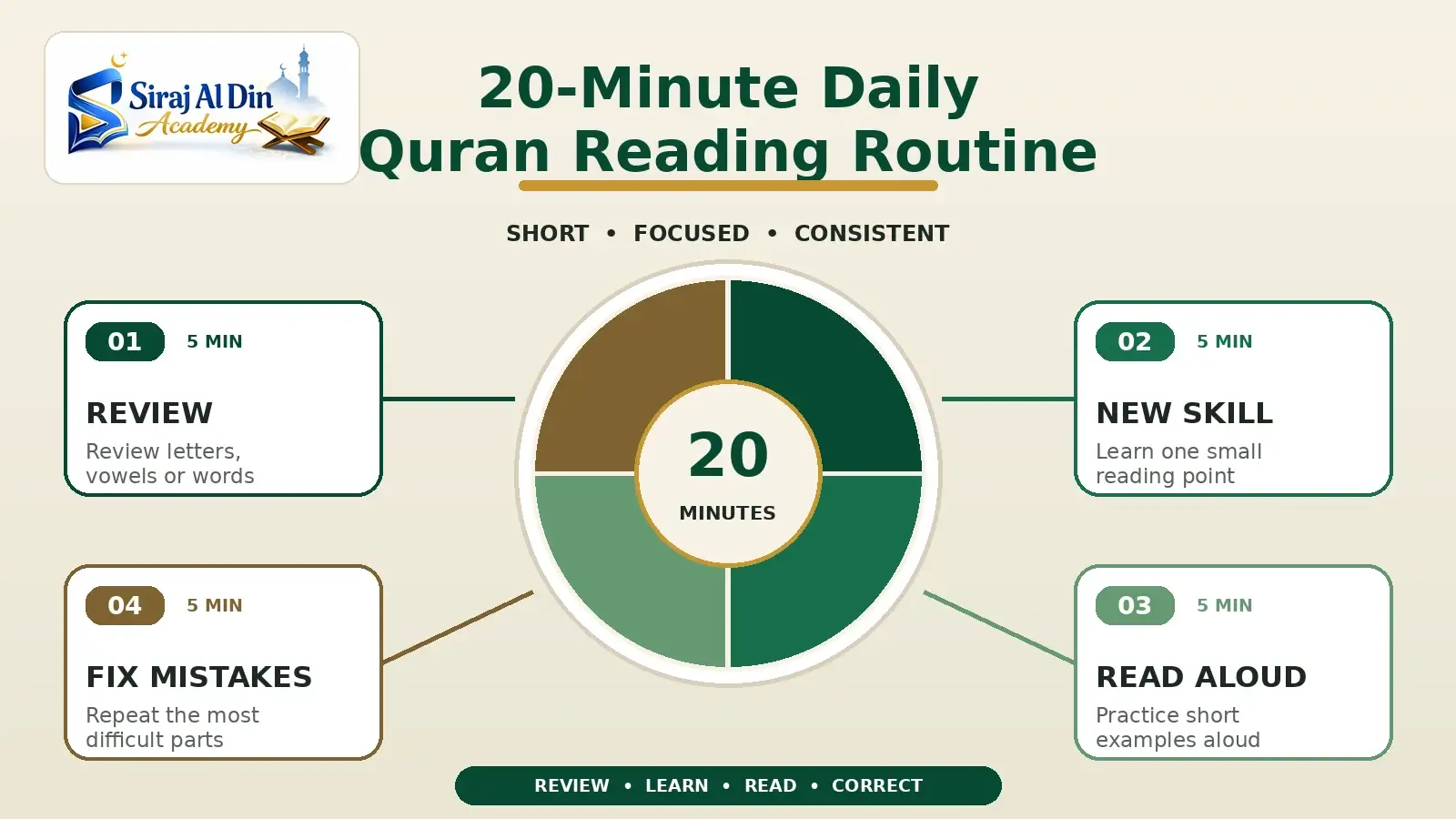
A focused twenty-minute routine can be very effective.
Spend the first few minutes reviewing material from the previous lesson. This may include letters, vowel combinations, or difficult words.
Then spend a short period learning one new skill.
After that, read examples aloud.
Reading aloud is important because pronunciation problems are much easier to notice when the sound is actually produced.
Finish the session by returning to the most difficult words or sounds.
Do not judge the session only by how much new material you covered.
A good session often ends with one or two difficult areas becoming clearer.
How Often Should Beginners Practice Quran Reading?
Short and frequent practice is usually more effective than occasional long sessions.
A learner may study with a teacher two or three times per week and still benefit greatly from short reading practice on the other days.
The important thing is regular contact with the skill.
When several days pass without reading, Arabic letters and patterns can begin to feel unfamiliar again, especially during the early stages.
Consistency helps recognition become automatic.
For children, even a short daily session may be enough.
Adults may find fifteen to thirty focused minutes realistic depending on work and family responsibilities.
The best practice routine is one that can actually continue.
How Children Should Learn Quran Reading
Children need structure, but they also need patience.
Young learners may lose concentration during long explanations.
Short practice, repetition, visual examples, live correction, and small achievable goals usually work better.
Do not expect every child to progress at the same speed.
One child may recognize letters very quickly but struggle with joining.
Another may read simple words comfortably but need more pronunciation practice.
Another may need repeated exposure before remembering vowel marks confidently.
The learning plan should adapt to the child instead of forcing every student through the same pace.
Children who need more structured practice and live pronunciation correction can continue through Online Quran Classes for Kids, with lessons adapted to their age and current reading level.
The goal is not only to help children finish lessons.
It is to give them a reading foundation they can continue using.
How Adults Can Start Reading Quran From Zero
Adults sometimes believe they are too old to begin learning Quran reading.
They are not.
An adult beginner can follow the same basic sequence:
letters, sounds, vowels, connected letters, words, verses, and eventually greater fluency.
The main difference may be the teaching style and schedule.
Adults often prefer direct explanations and may recognize patterns quickly.
At the same time, work and family responsibilities can reduce the amount of practice available.
Some adults are not actually beginning from zero.
They may have studied Quran as children but forgotten parts of the foundation.
In that situation, the first step is identifying where the weakness begins.
There is no reason for embarrassment.
Start from the skill you need.
Adults who prefer live guidance can use Online Quran Classes for Adults to begin from their actual reading level instead of following a one-size-fits-all starting point.
Common Mistakes Quran Reading Beginners Make
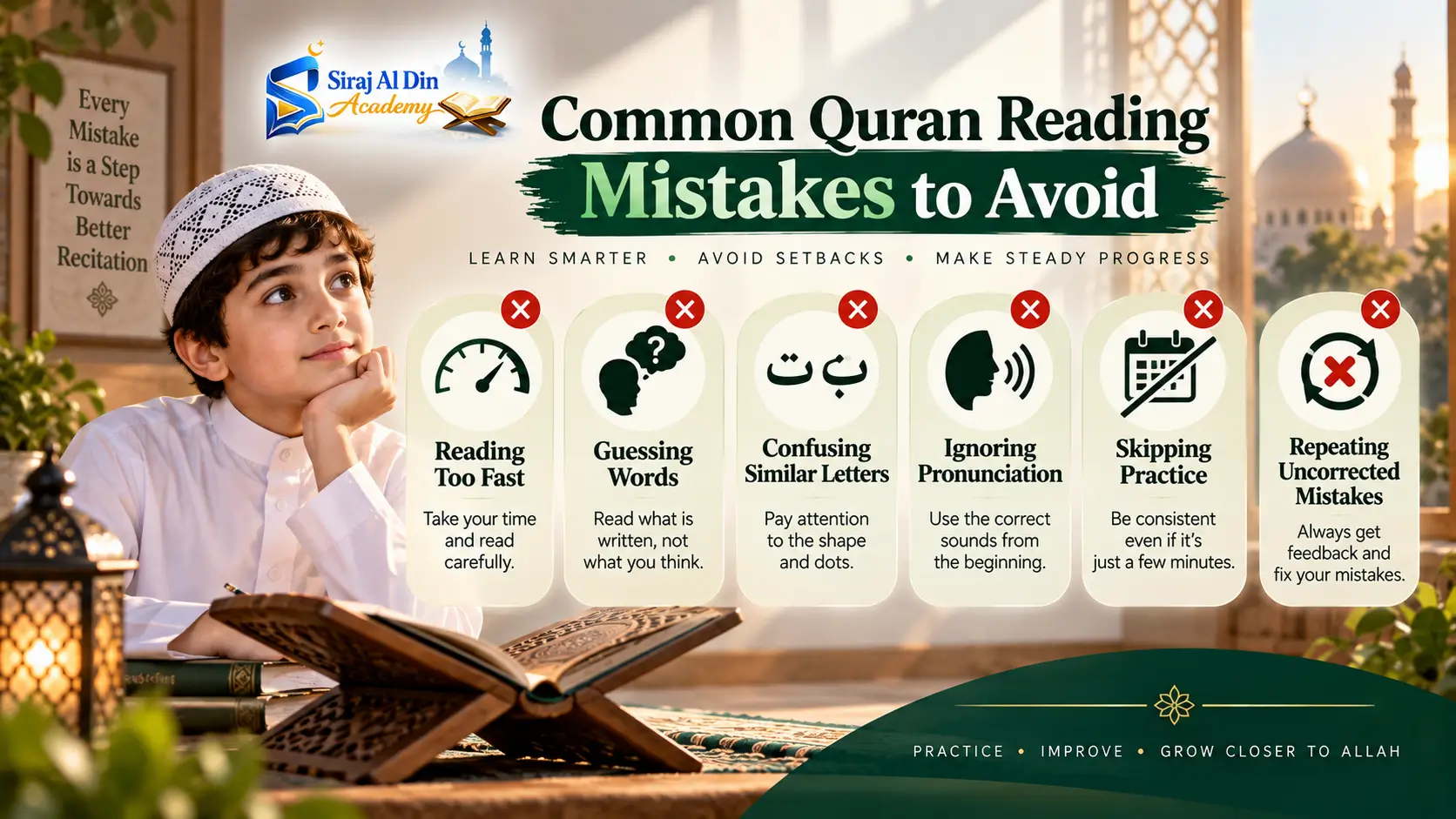
One of the most common mistakes is trying to read too quickly.
Beginners sometimes assume that faster reading means better reading.
It does not.
Slow, accurate reading builds the foundation for future fluency.
Another common problem is guessing.
When a word looks familiar, the learner may say what they expect to see rather than actually reading the letters and vowel marks.
Slow down and decode what is written.
Beginners can also ignore similar letters because the differences feel difficult.
Those differences should be practiced directly rather than avoided.
Another mistake is spending a lot of time memorizing rule names while doing very little actual reading.
Rules are useful, but reading is a practical skill.
Some learners also practice only during lessons.
A teacher can guide and correct, but repetition between lessons is what helps the skill become familiar.
Finally, avoid comparing your progress with another student.
A child, adult, Arabic speaker, and non-Arabic speaker may progress at very different speeds.
Your next lesson should depend on your current ability.
How Long Does It Take to Learn to Read the Quran?
There is no reliable single number of weeks or months for every beginner.
The timeline depends on the learner’s starting level, practice frequency, lesson schedule, pronunciation difficulty, age, previous exposure to Arabic, and consistency.
Someone who already recognizes Arabic letters may progress much faster than someone who is seeing them for the first time.
A learner who practices for a short period most days may progress more steadily than someone who studies for a long time only once every week.
Instead of asking only:
“How long will this take?”
Ask:
“What reading skill should I improve this week?”
That creates a practical goal you can control.
When Should You Start Reading Directly From the Mushaf?
There is no need to wait until every skill is perfect.
However, moving into the Mushaf should happen when the learner understands enough of the basic reading system to avoid constant guessing.
A teacher may introduce short Quranic examples before the entire beginner program is complete.
This can be very motivating.
The student begins to see how early exercises connect to actual Quran reading.
The transition should still be gradual.
Begin with a word.
Then a short line.
Then a short verse.
Over time, the Quran page begins to look less unfamiliar.
Should You Listen While Learning to Read?
Yes.
Listening can support Quran reading because it helps the learner hear pronunciation, rhythm, and correct word formation.
But audio should support the reading process rather than replace it.
If you always listen and repeat without decoding the letters yourself, you may memorize the sound of the passage while your reading ability remains weak.
A useful pattern is simple.
Look at the word.
Try to read it.
Listen carefully.
Compare what you said with what you heard.
Repeat it.
Then try again without depending completely on the audio.
Should You Memorize While Learning to Read?
Beginners can memorize short Surahs or verses while developing reading skills, especially with teacher guidance.
However, memorization should not hide weak reading.
A child may know a short Surah perfectly from listening but still be unable to read those same words from the page.
These are different abilities.
If your long-term goal includes Quran memorization, building a strong reading foundation can make future Hifz easier because you can recognize the words yourself and notice mistakes more effectively.
Reading and memorization can support each other, but they should not be confused.
When Do You Need a Quran Teacher?
Independent practice can help with recognition and repetition, but beginners sometimes reach a point where they need feedback.
A teacher is especially useful when you cannot distinguish similar sounds, are unsure about pronunciation, repeatedly make the same mistake, recognize letters but cannot join them, or simply do not know what to learn next.
The most important benefit is correction.
A beginner may repeat a sound incorrectly many times without realizing it.
Live feedback can prevent the mistake from becoming deeply established.
For learners who want a complete structured path, the Online Quran Reading Course for Beginners moves from letters and vowel marks to joined words, Quranic reading, fluency, and practical Tajweed with one-to-one correction.
A good teacher should not simply make you read more pages.
The teacher should identify the skill that is holding your reading back.
What Should Your First Quran Lesson Look Like?
A good first lesson should not assume that every beginner is identical.
The teacher should first check what you can already do.
You may be asked to recognize some letters, produce several sounds, read simple vowel combinations, join a few letters, or attempt a short word.
A complete beginner may genuinely need to begin with the first letters.
Someone returning after many years may start much further ahead.
This assessment should not feel like an exam.
Its purpose is simply to find the correct starting point and avoid wasting time on material you already know.
What Comes After Basic Quran Reading?
Once you can read Quranic text with greater confidence, several learning paths become possible.
You may decide to focus on reading fluency.
You may study Tajweed more deeply.
You may begin Quran memorization.
You may work on correcting pronunciation habits that became established earlier.
Or you may combine several goals gradually.
There is no need to begin everything at the same time.
A strong learning journey usually works better when one layer is reasonably stable before the next becomes the main focus.
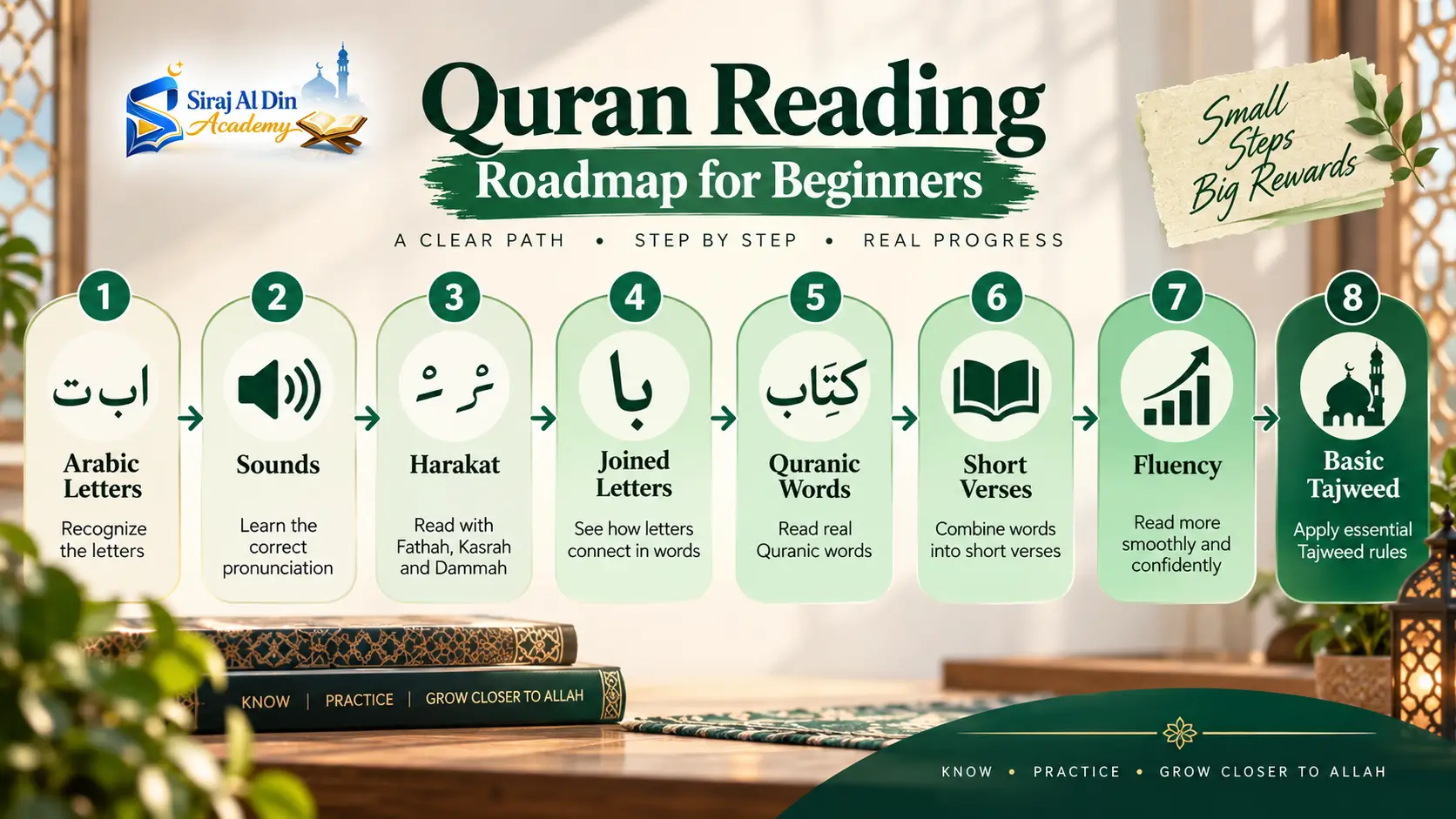
A Step-by-Step Quran Reading Roadmap
For a complete beginner, the journey can be thought of as a clear progression.
First, recognize the Arabic letters.
Then learn their basic sounds.
Learn how letters appear when connected.
Add Fathah, Kasrah, and Dammah.
Then study Sukoon, Shaddah, and Tanween.
Begin joining letters into simple words.
Move into Quranic word patterns.
Read short phrases.
Then read short verses.
Repeat familiar passages to improve fluency.
Introduce basic Tajweed gradually.
Finally, continue regular reading with correction.
These stages naturally overlap.
For example, pronunciation correction begins long before a student formally studies Tajweed.
The roadmap is not designed to make learning rigid.
It simply makes the direction clear.
Final Advice for Quran Reading Beginners
If you are starting from zero, do not open a complete Quran page and judge yourself by everything you cannot yet read.
Focus on the next skill.
Learn the letters.
Learn their sounds.
Add the vowel marks.
Join the letters.
Read one word.
Then another.
Move to a short phrase.
Read one verse.
Repeat it.
Correct the mistakes.
Then keep going.
Learning to read the Quran is not one enormous skill.
It is a collection of smaller skills that gradually become connected.
Consistency matters more than rushing.
Accuracy matters more than speed.
And correction is more useful than repeating the same mistake many times.
If you want to understand how live online lessons work before choosing a learning path, read our guide to online Quran classes for beginners. It explains lesson structure, teacher support, and the different learning paths available for children and adults.
Once you understand your starting level, you can choose whether your next step should be beginner Quran reading, general Quran classes, Tajweed, or eventually Quran memorization.
Frequently Asked Questions
Can I learn to read the Quran if I do not speak Arabic?
Yes. You can learn Arabic letters, pronunciation, vowel marks, connected forms, and Quran reading without speaking conversational Arabic.
What should a Quran beginner learn first?
Begin with Arabic letters and their sounds. After that, learn connected forms, short vowel marks, other common reading signs, and simple word reading before progressing into Quranic verses.
Do I need to learn Tajweed before reading the Quran?
No. Correct pronunciation should begin early, but you do not need to master every Tajweed rule before learning how to read. Tajweed can be introduced gradually as your reading improves.
How long does it take a beginner to learn Quran reading?
There is no fixed timeline. Progress depends on the student’s starting point, lesson frequency, practice, age, pronunciation, previous Arabic experience, and consistency.
Can adults learn to read the Quran from zero?
Yes. Adults can begin with the Arabic alphabet and gradually progress through vowels, joined letters, words, verses, fluency, and Tajweed.
What age should children start learning Quran reading?
There is no single required age. Children can begin when they are ready to recognize and practice letters, as long as the teaching method matches their age and attention span.
Should I learn Arabic before learning Quran reading?
No. Conversational Arabic and Arabic grammar are not prerequisites for learning to read Quranic text.
How often should beginners practice Quran reading?
Short, regular practice is usually more effective than occasional long sessions. Even fifteen to twenty focused minutes can be valuable when repeated consistently.
Can I learn Quran reading by myself?
Independent practice can help, especially with letters and repetition. However, teacher feedback is useful for pronunciation and mistakes that may be difficult to notice alone.
Should beginners use a Qaida?
A structured Qaida can be very helpful because it organizes the reading skills in a gradual sequence before the learner moves into longer Quranic passages.
What is the difference between Quran reading and Tajweed?
Quran reading is the ability to recognize and correctly read the text. Tajweed provides more detailed pronunciation and recitation rules that help the reader recite accurately.
What should I study after learning basic Quran reading?
After building a reliable reading foundation, you can improve fluency, study Tajweed in greater depth, begin memorization, or continue with a broader Quran learning program.