 Siraj Al Din Academy
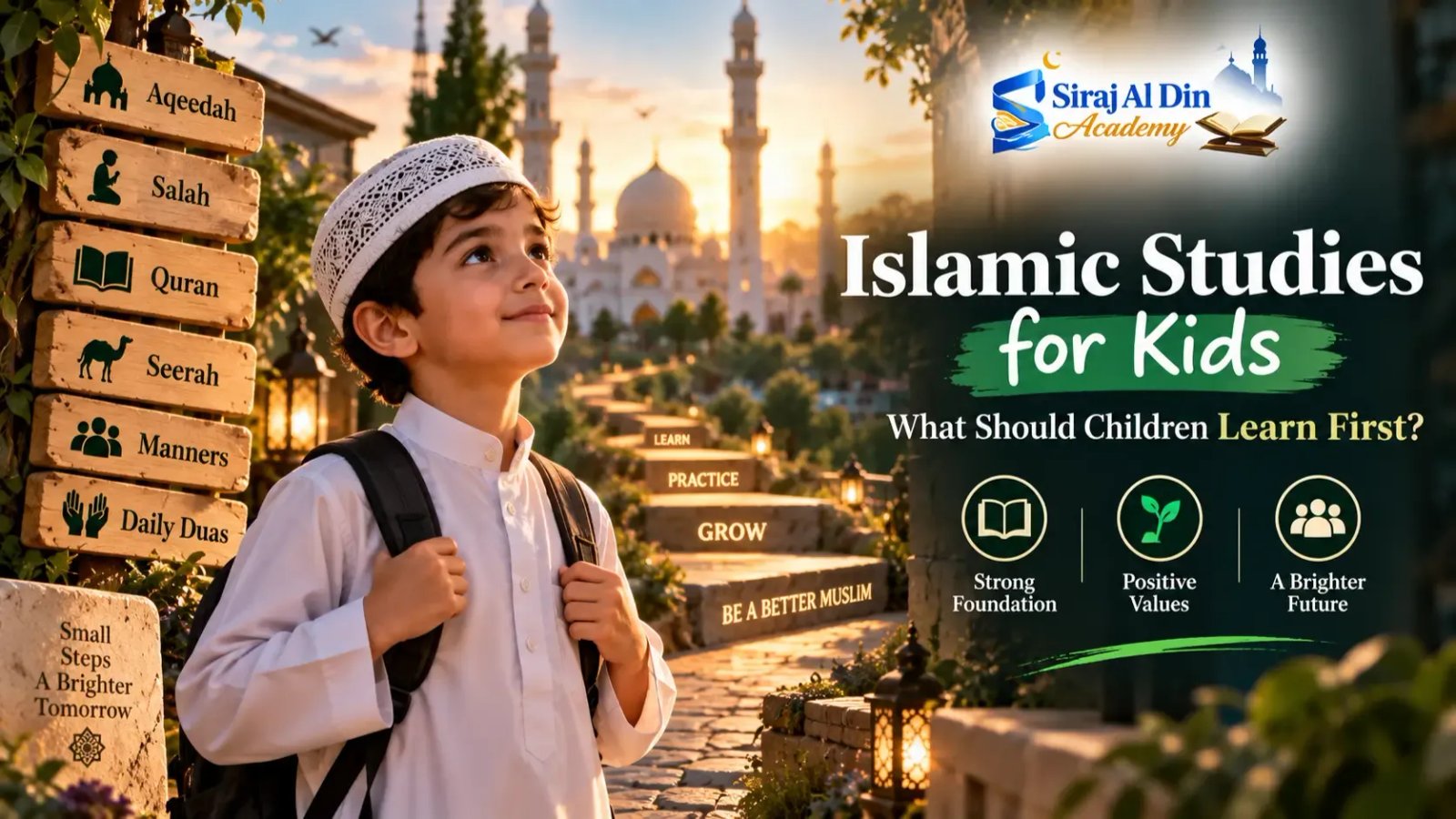
Parents often know that they want their children to learn Islam, but deciding what to teach first can be surprisingly difficult.
Should a young child begin with Aqeedah? Should parents focus on Salah? Is it better to teach daily duas first? When should children start learning Seerah? How much should they know about halal and haram? And how can families teach all of this without making Islamic Studies feel like a long list of facts to memorize?
A strong Islamic education does not need to begin with complicated terminology.
For children, the best starting point is usually a simple foundation that helps them understand who they are as Muslims, what Muslims believe, how Muslims worship, and how Islamic teachings connect to everyday life.
The aim is not to give a child every detail at once.
The aim is to build a foundation that can grow with them.
This guide explains what children should learn first in Islamic Studies, how the learning order can change with age, and how parents can build an Islamic learning routine that is practical, positive, and appropriate for their child.
What Is Islamic Studies for Kids?
Islamic Studies for children is broader than memorizing information about Islam.
A well-rounded program may gradually introduce children to:
- basic Islamic beliefs,
- the pillars of Islam and Iman,
- Salah and Wudu,
- Seerah,
- stories of the Prophets,
- Islamic manners and character,
- daily duas,
- basic worship,
- and practical Islamic responsibilities.
The exact level should depend on the child’s age, maturity, existing knowledge, and ability to understand the lesson.
A five-year-old and a twelve-year-old may study the same general subject, such as Salah, but they should not be taught in exactly the same way.
Young children usually need simple explanations, stories, repetition, and practical examples.
Older children can gradually study more detail, understand reasons and responsibilities, and begin connecting different areas of Islamic knowledge together.
What Should Children Learn First?
There is no single curriculum that every family must follow in exactly the same order.
However, a useful foundation usually begins with five connected areas:
belief, worship, character, Islamic identity, and practical daily habits.
Children should first understand the basic ideas that help the rest of Islamic learning make sense.
For example, before giving a child a long list of rules about Salah, it helps if the child already understands that Salah is an important act of worship and a regular part of Muslim life.
Before teaching detailed Islamic rulings, a child benefits from learning honesty, kindness, respect, responsibility, and awareness that Islam guides how Muslims behave.
The goal is to build understanding before complexity.
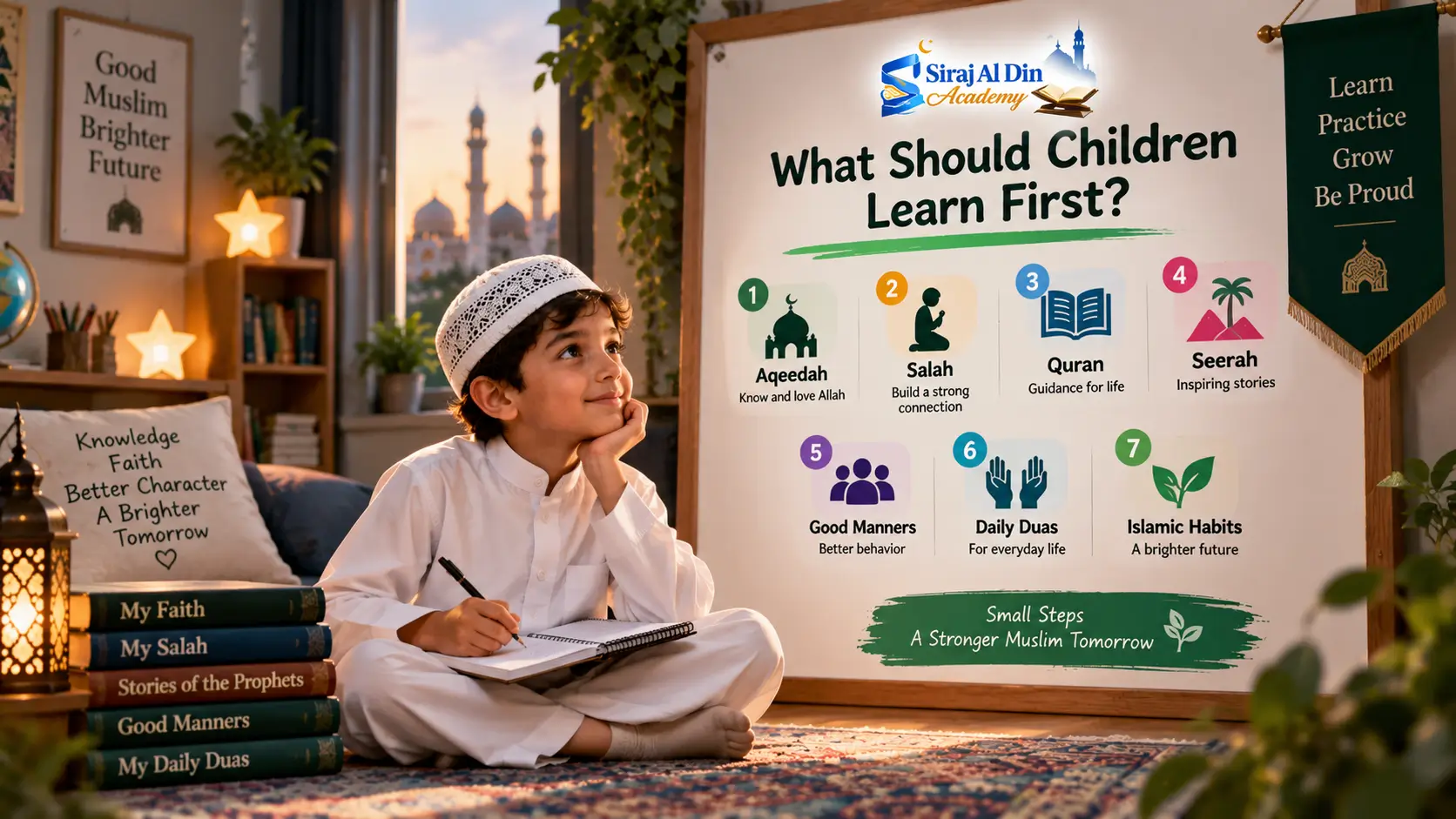
1. Begin With Simple Aqeedah
One of the first areas children can learn is basic Aqeedah.
For a young child, this does not need to begin with advanced theological vocabulary.
Start with simple ideas.
Children can learn that Allah created them, that Muslims worship Allah, that Allah knows and cares about His creation, and that Muslims try to live according to what Allah has taught.
As children grow, they can gradually learn the pillars of Iman and understand belief in Allah, the angels, the revealed books, the Prophets, the Last Day, and divine decree.
The important point is to match the explanation to the child.
A young learner may need a short conversation and a simple example.
An older student may be ready to ask deeper questions.
Children should also feel comfortable asking questions.
When Islamic Studies becomes a space where a child is afraid to ask “why?” or “what does this mean?”, the teacher may miss an important opportunity to build understanding.
2. Teach the Five Pillars of Islam
The five pillars give children a useful framework for understanding some of the most important practices in Islam.
Children can gradually learn about:
Shahadah, Salah, Zakah, fasting in Ramadan, and Hajj.
At the beginning, the purpose is not to teach every legal detail.
The child should first understand the basic meaning and importance of each pillar.
For example, when teaching Salah, explain that Muslims pray regularly as part of worship.
When teaching Ramadan, explain fasting in language suitable for the child’s age.
When discussing Hajj, children can learn that Muslims from around the world travel to Makkah for this important act of worship.
Over time, these basic ideas can become more detailed.
This approach helps children build a mental map of Islam before studying individual topics more deeply.
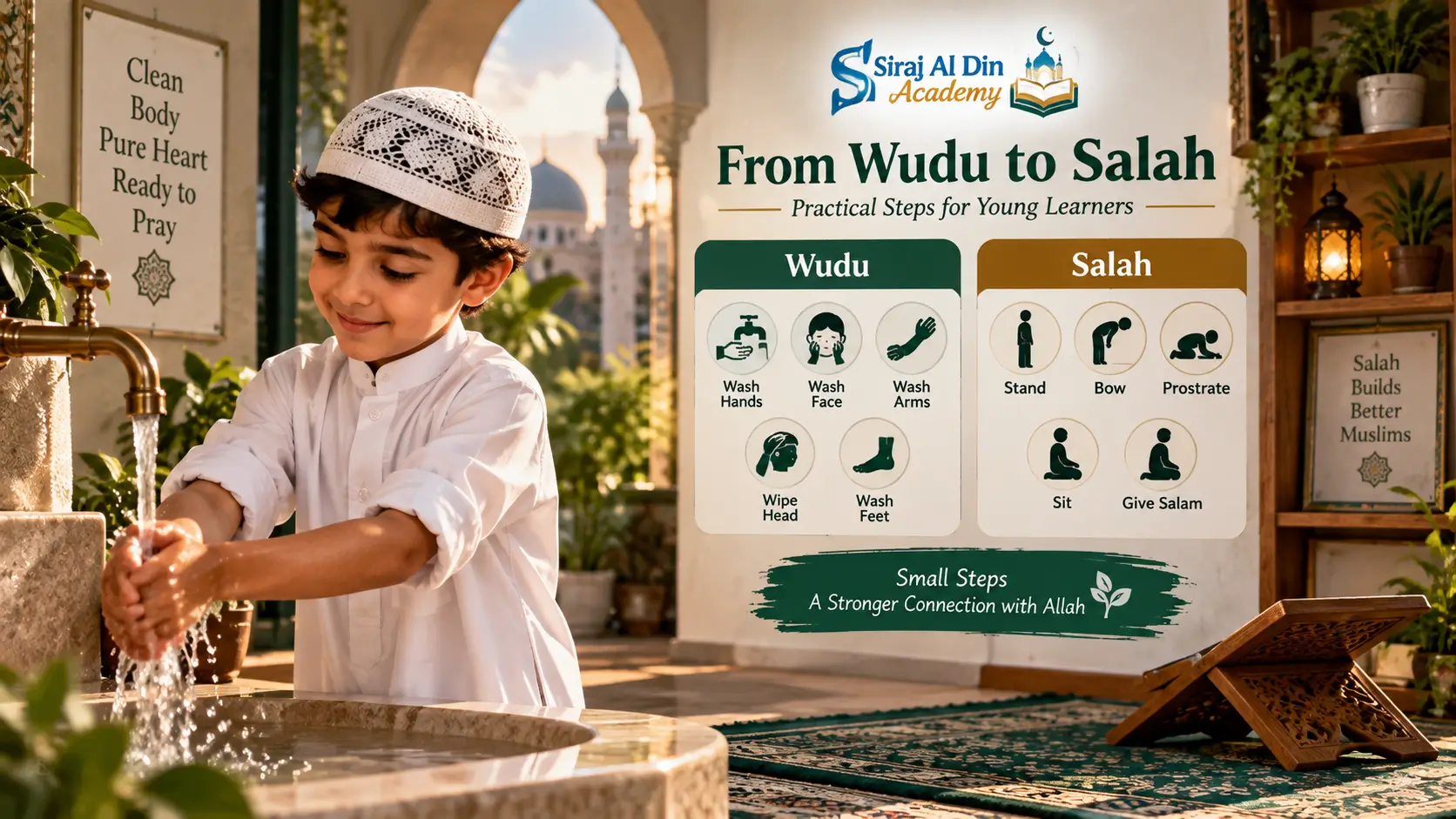
3. Teach Wudu Practically
Wudu is an excellent subject for children because it combines knowledge with practice.
Instead of only explaining the steps verbally, show the child how Wudu is performed.
Let them practice.
Correct one step at a time.
Children often remember practical lessons better when they can see and do something themselves.
A younger child may simply learn the correct sequence.
An older child can gradually understand why purification is important, when Wudu is needed, and what affects it.
Avoid trying to explain every possible situation in the first lesson.
Start with the routine the child actually needs.
Then build from there.
4. Teach Salah Step by Step
Salah is one of the most important practical areas of Islamic education for children.
But it should be taught gradually.
A child learning Salah may first need to know when Muslims pray.
Then they can learn the movements.
After that, they can become more familiar with what is recited and the correct sequence.
Trying to teach every detail in one session can make prayer feel complicated.
A better approach is to divide the process.
One lesson may focus on preparing for prayer.
Another may focus on the physical order.
Another may review common mistakes.
The child should repeatedly practice until the basic routine becomes familiar.
Parents can reinforce this learning by allowing children to observe and participate naturally in the family’s prayer routine.
5. Build Islamic Manners From the Beginning
Islamic Studies should not become a subject that exists only during class.
Children also need to understand how Islamic teachings affect behavior.
This is where manners and character become especially important.
Children can learn about honesty, kindness, patience, gratitude, respect for parents, responsibility, keeping promises, helping others, and speaking politely.
These lessons become much stronger when connected to real situations.
Instead of only saying:
“Islam teaches kindness,”
ask:
“What could you do if a new child at school is sitting alone?”
Instead of only teaching that children should respect parents, talk about what respectful behavior looks like during an ordinary day.
Islamic character becomes meaningful when children can recognize it in their own lives.
The current Islamic Studies program at Siraj Al Din Academy also includes practical character topics such as honesty, kindness, patience, gratitude, respect, and responsibility, rather than treating Islamic learning as information alone.
6. Introduce Daily Duas as Habits
Children can begin learning simple daily duas gradually.
The important thing is not to give them a very long list immediately.
Choose duas connected to routines the child already experiences.
For example, daily learning may be connected to waking, sleeping, eating, leaving or entering the home, and other common activities.
One or two duas practiced consistently can become stronger than many duas introduced quickly and forgotten.
Parents can help by using the same routine at home.
When the child sees that Islamic learning is connected to real life, the dua stops feeling like homework and becomes part of the day.
7. Teach Seerah Through Meaningful Stories
Children often connect very naturally with stories.
This makes Seerah one of the strongest tools for Islamic education.
But the aim should not be to turn Seerah into a list of dates and names.
Children should learn about the life of Prophet Muhammad ﷺ in a way that helps them understand his character, patience, mercy, courage, leadership, and trust in Allah.
After a story, ask a simple question:
“What can we learn from this?”
This moves the lesson from information to reflection.
Younger children may benefit from short stories with one clear lesson.
Older children can begin understanding historical context, important events, and how different parts of the Seerah connect.
The academy’s current Islamic Studies course follows this practical approach by using Seerah lessons to highlight qualities and lessons children can apply in their own lives.
8. Add Stories of the Prophets
Stories of the Prophets can help children build a broader understanding of faith, patience, obedience, courage, and trust in Allah.
Again, the lesson should match the child’s age.
Young children do not need every historical detail.
Choose the central lesson.
As they grow, the stories can become more detailed and children can begin comparing themes between different Prophets.
Parents and teachers should also avoid turning every story into a long lecture.
A memorable story followed by one thoughtful conversation may stay with a child much longer.
9. Introduce Halal and Haram Gradually
Children eventually need to understand that Islam includes guidance about what Muslims should and should not do.
However, this subject should be introduced carefully and appropriately.
Young children can begin with simple distinctions connected to their real life.
As they become older, they can study responsibilities in more detail.
Avoid making early Islamic education feel like nothing but restrictions.
Children should understand both the positive actions Islam encourages and the actions Muslims avoid.
Islamic Studies should help the child develop judgment, not simply fear making a mistake.
10. Connect Islamic Studies With Quran Learning
Islamic Studies and Quran learning support each other, but they are not exactly the same subject.
A Quran lesson may focus on:
Arabic letters, Quran reading, pronunciation, Tajweed, recitation, or memorization.
Islamic Studies focuses more on beliefs, worship, Seerah, character, duas, and practical Islamic knowledge.
For many children, combining both creates a stronger overall learning experience.
For example, a child may be learning Quran reading in one lesson while studying Salah, Seerah, or manners in Islamic Studies.
Families who want dedicated Quran instruction can also use Online Quran Classes for Kids alongside Islamic Studies. Siraj Al Din Academy’s current Quran program for children includes reading, pronunciation, basic Tajweed, memorization support, revision, and individual teacher feedback.
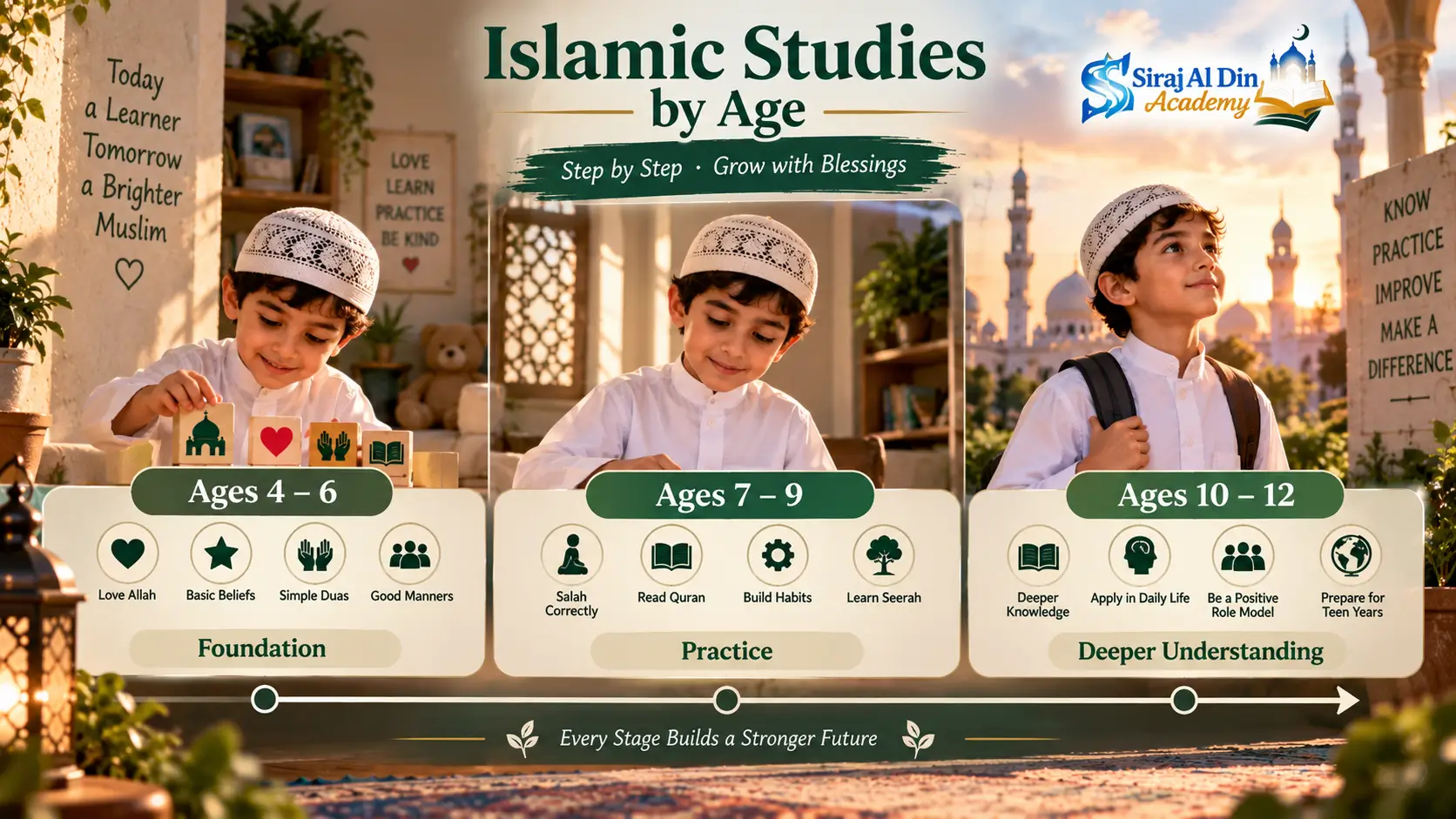
Islamic Studies for Ages 4–6
For younger children, keep Islamic learning simple and positive.
At this stage, the goal is familiarity.
Children can begin learning:
basic belief in Allah, simple Islamic identity, short daily duas, basic manners, simple stories, recognition of Salah as part of Muslim life, and very basic Wudu practice.
Lessons should usually be short.
Repetition is important.
Stories, pictures, questions, games, and practical demonstrations may work better than long explanations.
Do not worry if the child cannot remember every definition.
You are building familiarity.
Islamic Studies for Ages 7–9
Children in this age range can usually begin following a more structured learning path.
They may study:
the five pillars of Islam, pillars of Iman, Salah more carefully, Wudu, simple Seerah, stories of Prophets, daily duas, Islamic manners, and basic responsibilities.
They can also begin answering short questions in their own words.
This is useful because it shows whether the child actually understands the lesson rather than simply repeating sentences.
Islamic Studies for Ages 10–12
Older children can begin studying topics in greater depth.
They may be ready for:
more detailed Aqeedah, practical Fiqh topics relevant to their life, deeper Seerah, personal responsibility, Islamic character, halal and haram concepts, worship, and discussion-based learning.
At this stage, children often ask more complicated questions.
That is healthy.
A good teacher should make space for those questions.
The goal should be to help the student understand Islam thoughtfully, not simply collect information.
What About Teenagers?
Teenagers need a different approach from young children.
They are more likely to ask questions about identity, responsibility, friendships, social pressure, worship, personal choices, and why Muslims believe or practice certain things.
Repeating the same child-level curriculum may not be enough.
Teen Islamic education should gradually become more discussion-based.
Teachers can encourage students to think carefully, ask questions, and understand how Islamic principles apply to situations they actually face.
A Simple Weekly Islamic Studies Plan for Kids
Parents do not need to teach every subject every day.
A simple weekly structure might look like this:
Monday: Aqeedah or pillars of Islam
Tuesday: Salah or Wudu practice
Wednesday: Seerah
Thursday: Islamic manners and character
Friday: Daily dua or practical Islamic habit
Weekend: Review, discussion, or family activity
This is only an example.
The same subjects can be rotated differently depending on the child’s age and class schedule.
The important thing is balance.
A child should not spend months learning only one area while never touching worship, character, or Seerah.
How Long Should an Islamic Studies Lesson Be?
Lesson length should depend on age and attention.
A young child may learn more from a focused 20-minute lesson than a long class filled with information.
Older children can usually manage longer sessions, especially when the teacher uses discussion and questions.
What matters is not only lesson duration.
The quality of engagement matters too.
A lesson should give the child enough time to understand the main idea, practice or discuss it, and leave with one or two things to remember.
How Often Should Children Study Islamic Studies?
Consistency is more important than trying to do everything quickly.
One or two structured lessons per week can work well when families also reinforce the learning at home.
Other children may benefit from more frequent sessions.
The ideal schedule depends on age, attention span, family routine, and the number of subjects being studied.
Avoid creating such a heavy schedule that Islamic learning becomes something the child constantly wants to escape from.
Long-term consistency is the better goal.
How Parents Can Support Islamic Learning at Home
Parents do not need to turn the home into a classroom.
Simple reinforcement can make lessons much stronger.
After class, ask:
“What did you learn today?”
Let the child explain.
If they studied Wudu, practice it.
If they studied honesty, notice examples during the week.
If they learned a dua, use it at the appropriate time.
If they learned a Seerah story, ask what lesson they remember from it.
These short conversations help knowledge move from the class into everyday life.
Do Parents Need to Be Islamic Studies Teachers?
No.
Parents play an important role, but they do not have to know how to teach every topic in detail.
Their role can be to:
support regular learning, encourage questions, reinforce good habits, communicate with the teacher, and help children practice what they have learned.
When a question requires knowledge beyond what the parent knows, it is perfectly reasonable to ask a qualified teacher.
Children can also learn something valuable from seeing adults say:
“I am not sure. Let us find out correctly.”
How to Choose an Islamic Studies Teacher for Your Child
A knowledgeable teacher is important, but knowledge alone is not enough for children.
A good teacher for kids should also understand how to explain ideas simply.
Look for someone who can:
communicate patiently, adjust lessons to the child’s age, encourage questions, use practical examples, review previous topics, and build a respectful relationship with the student.
A teacher should know when a child needs a simpler explanation and when an older learner is ready for more detail.
One reason one-to-one lessons can help is that the teacher can adapt the pace and explanation to the individual child. Siraj Al Din Academy’s current Islamic Studies program uses live individual lessons and adjusts the material according to age, existing knowledge, and learning ability.
Common Mistakes When Teaching Islamic Studies to Kids
One common mistake is teaching too much information too quickly.
A child may memorize several definitions without understanding any of them.
Another mistake is focusing only on rules.
Children also need faith, character, Seerah, positive identity, and practical habits.
Another problem is teaching everything at the same difficulty level.
A five-year-old and a twelve-year-old should not receive identical explanations.
Some families also introduce many new topics but rarely review them.
Revision is not only for Quran memorization.
Children also need to revisit Islamic Studies concepts so they become familiar and meaningful.
Finally, avoid making every Islamic conversation feel like a test.
Questions and discussion matter.
How Do You Know If Your Child Is Making Progress?
Progress is not only measured by how many chapters have been completed.
Look for signs such as:
the child can explain a concept in simple words, remembers the main steps of Wudu, recognizes the importance of Salah, recalls lessons from Seerah, uses Islamic manners more consciously, remembers daily duas, asks thoughtful questions, and connects Islamic learning to everyday situations.
These are meaningful signs of understanding.
A child who finishes a large curriculum but cannot explain what they learned may need more review.
Should Islamic Studies Be Memorization or Understanding?
Children need some memorization.
There are important terms, duas, names, and concepts they will need to remember.
But memorization should not replace understanding.
A useful pattern is:
learn → understand → practice → review.
For example, if the child learns the pillars of Islam, make sure they understand what each one refers to.
If they learn about honesty, give practical examples.
If they learn Wudu, practice it physically.
When information has meaning, it is usually easier to remember.
What Should a Complete Beginner Start With?
If a child has had very little formal Islamic education, do not try to “catch up” by teaching everything at once.
Start with a simple foundation:
basic belief, Muslim identity, five pillars, Salah, Wudu, daily manners, simple duas, and short Seerah stories.
From there, the teacher can gradually expand.
This foundation gives the child enough context to understand future Islamic Studies lessons.
Can Islamic Studies Be Learned Online?
Yes.
Online Islamic Studies can work well for children when the lesson is interactive and age-appropriate.
The teacher should not simply lecture while the child listens.
A useful online lesson can include:
questions, short explanations, visual material, repetition, practical demonstrations, stories, review, and conversation.
Individual lessons can also allow the teacher to slow down when the child needs help or move forward when a topic is already understood.
Siraj Al Din Academy currently offers live one-to-one Islamic Studies lessons covering Aqeedah, pillars of Islam and Iman, Salah, Wudu, Seerah, manners, duas, and practical Islamic knowledge.
What Should the First Islamic Studies Lesson Cover?
The first lesson does not need to contain a large amount of new information.
It is often more useful to understand what the child already knows.
A teacher may ask simple questions about:
basic beliefs, Salah, Wudu, common duas, Seerah, and Islamic manners.
The purpose is not to embarrass the child.
It helps identify the correct starting level.
A child who already understands the basics of Salah may need a different lesson from a child who has never studied it.
Building a Long-Term Islamic Learning Path
A strong Islamic education develops over years.
The same topics may appear more than once.
That is normal.
A child might learn a simple version of the pillars of Iman at age six and study them again more deeply several years later.
They may hear a Seerah story when young and later return to the same event with greater historical and spiritual understanding.
This is not unnecessary repetition.
It is progression.
Good Islamic Studies builds layers.
The foundation becomes stronger as the child grows.
Final Advice for Parents
Do not measure Islamic education only by how much content your child finishes.
Start with the foundation.
Teach belief simply.
Make Salah and Wudu practical.
Use Seerah to build understanding and character.
Connect manners to everyday situations.
Introduce daily duas gradually.
Allow questions.
Review regularly.
Most importantly, choose a learning path that matches your child’s age and current knowledge.
Islamic education should grow with the child.
A well-structured program can help families avoid random lessons and create a clear progression from basic Islamic knowledge to deeper understanding.
Families who want structured individual support can explore the Online Islamic Studies for Kids course. The current program includes Aqeedah, Salah, Wudu, Seerah, manners, daily duas, and age-appropriate practical Islamic learning.
Children who also need Quran reading, Tajweed, or memorization support can combine Islamic Studies with Online Quran Classes for Kids.
Frequently Asked Questions
What should children learn first in Islamic Studies?
A good foundation includes simple Aqeedah, the pillars of Islam, Salah, Wudu, Islamic manners, daily duas, and age-appropriate Seerah.
At what age should children start Islamic Studies?
Children can begin learning simple Islamic concepts from a young age. The content and teaching style should match their age and ability to understand.
Should children learn Aqeedah first?
Basic Aqeedah is an important foundation, but it can be taught alongside practical topics such as Salah, manners, duas, and Seerah rather than as an isolated subject.
How should young children learn Islam?
Young children usually respond well to short explanations, stories, practical demonstrations, repetition, questions, and simple routines.
How long should Islamic Studies classes for kids be?
The ideal length depends on age and attention span. Younger children may benefit from shorter focused lessons, while older children can usually handle longer discussion-based sessions.
What is the difference between Quran classes and Islamic Studies?
Quran classes mainly focus on Quran reading, pronunciation, Tajweed, recitation, and memorization. Islamic Studies focuses on beliefs, worship, Seerah, manners, duas, and practical Islamic knowledge.
Should children memorize Islamic Studies lessons?
Some memorization is useful, but understanding and practical application should also be part of the learning process.
Can children learn Islamic Studies online?
Yes. Online classes can work well when lessons are live, interactive, age-appropriate, and adapted to the child’s level.
How can parents support Islamic Studies at home?
Parents can ask children what they learned, practice simple lessons together, reinforce Islamic manners, use daily duas, and communicate with the teacher about progress.
What should older children learn after the basics?
Older children can gradually study Aqeedah in greater depth, Fiqh topics relevant to their life, more detailed Seerah, Islamic responsibilities, character, and practical decision-making.
Can Islamic Studies and Quran classes be combined?
Yes. Many families combine Islamic Studies with Quran reading, Tajweed, or memorization so children develop both Islamic knowledge and Quran skills.
How do I know where my child should start?
Begin by checking what the child already understands. A teacher can assess their current knowledge and build a plan around the topics they need next.