 Siraj Al Din Academy
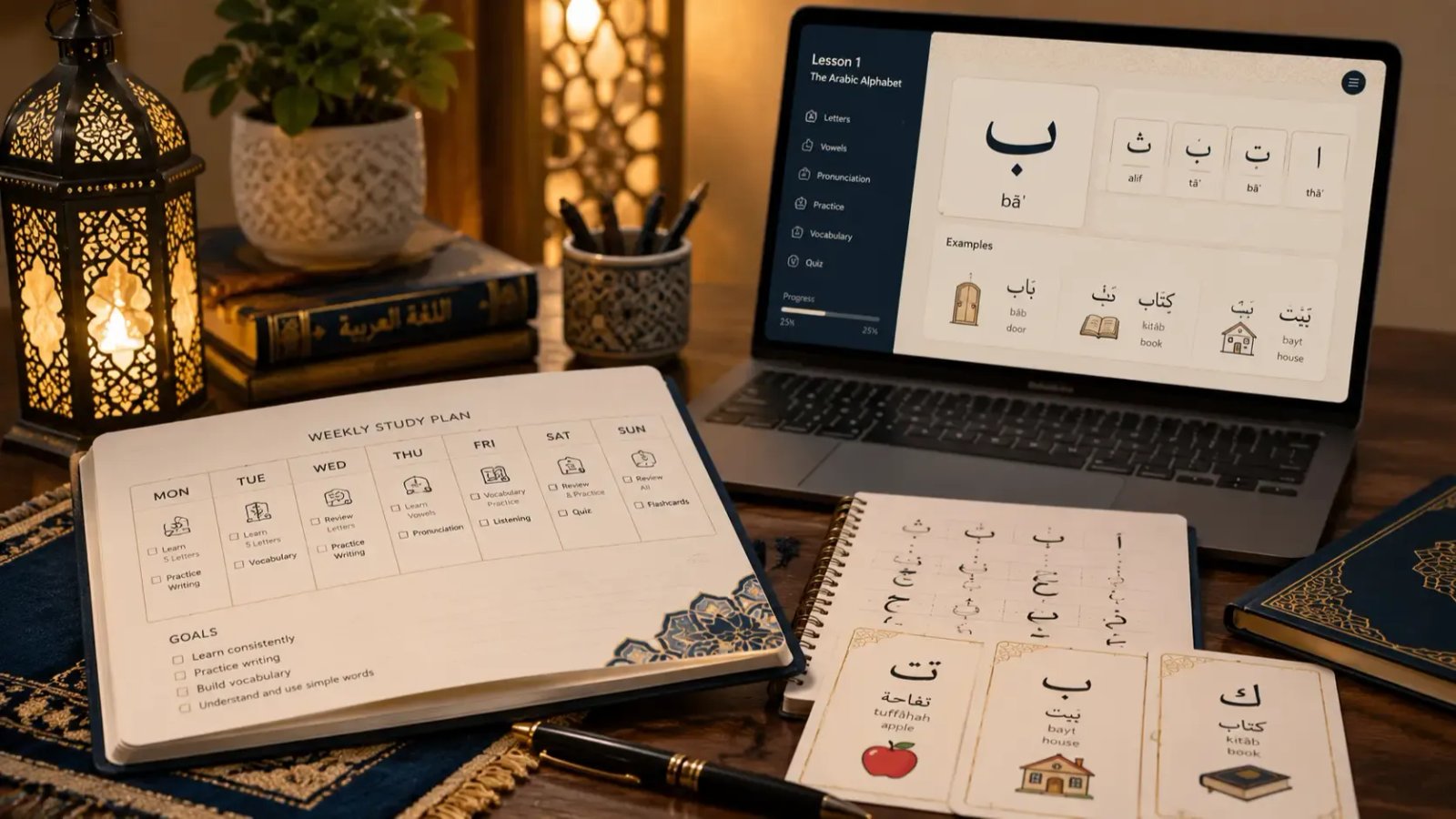
Learning Arabic can feel difficult at the beginning, especially for non-native speakers. Some students do not know the Arabic alphabet yet. Others can recognize a few letters but struggle to read words, understand pronunciation, or build sentences. Many parents also want their children to learn Arabic so they can read the Quran, understand Islamic words, and stay connected to their Muslim identity.
The good news is that beginners do not need a complicated plan. A simple weekly Arabic learning plan can help students build confidence step by step. The key is not to study for many hours once and then stop. The key is consistency. A short Arabic lesson every day, with clear goals and regular revision, is usually better than a long lesson without follow-up.
This guide explains a practical weekly Arabic plan for beginners, especially children, adults, and non-native Arabic speakers. It also shows what to study first, how to practice reading and speaking, how parents can help children at home, and when it may be useful to join structured Arabic classes online.
Why Arabic Is Important for Beginners
Arabic is not only another language for many Muslim families. It is connected to Quran reading, prayer, Islamic words, daily duas, and a stronger understanding of Islamic studies. A student who learns Arabic gradually can become more confident when reading Quranic words, recognizing letters, and understanding common Islamic expressions.
For non-native speakers, Arabic may look difficult because the letters, sounds, and writing direction are different from English and many other languages. However, when Arabic is taught step by step, it becomes much easier. Beginners should not be rushed into long texts. They should start with letters, sounds, short words, and simple sentences.
Arabic learning also helps children develop a stronger connection with their family’s values and identity. Even if the child lives in Europe, the UK, the US, Canada, Australia, or another non-Arabic-speaking country, regular Arabic practice can help them feel more familiar with Quran learning and Islamic education.
Who This Weekly Arabic Plan Is For
This weekly Arabic plan is suitable for complete beginners who do not know the Arabic alphabet. It is also useful for students who know some letters but cannot read smoothly yet. Parents can use it with children, and adults can use it for self-study or alongside a teacher.
The plan is especially helpful for non-native Arabic speakers who need a clear structure. Many students fail not because Arabic is impossible, but because they study randomly. One day they learn letters, another day they try grammar, then they stop because there is no routine. A weekly plan fixes this problem by giving every day a small purpose.
This plan is also useful for families who want Arabic to support Quran learning. A child who can recognize Arabic letters and sounds will usually find Quran reading easier later. That is why Arabic Classes for Non-Native Speakers can be a strong foundation for students who want to improve Quran reading and pronunciation.
What Beginners Should Learn First
A beginner should start with the Arabic alphabet, but not by memorizing letter names only. The student needs to recognize each letter, hear its sound, pronounce it correctly, and understand how it changes shape at the beginning, middle, and end of a word.
After letters, the student should learn short vowels, known as Harakat. These include Fatha, Kasra, and Damma. Harakat are very important because they help the student read Arabic words correctly. Without them, beginners may guess the pronunciation and build weak reading habits.
The next step is joining letters into short words. This stage should be slow and practical. The student should read simple examples many times until reading becomes more natural. After that, the student can move to short phrases and simple sentences.
Beginners should also learn useful vocabulary from the beginning. Words such as book, pen, house, family, teacher, student, prayer, mosque, and Quran are simple and meaningful. Learning vocabulary connected to daily life and Islamic learning makes Arabic more useful and easier to remember.
A Simple Weekly Arabic Learning Plan
A good Arabic plan for beginners should include reading, vocabulary, listening, speaking, writing, and revision. The student does not need to master everything in one week. The goal is to repeat this structure every week with new letters, words, and sentences.
Day 1 should focus on Arabic letters and sounds. The student can learn three to five letters, repeat their sounds, and practice recognizing them in different positions. It is better to learn fewer letters correctly than many letters without confidence.
Day 2 should focus on vocabulary. The student can learn five to ten useful words related to one topic, such as family, home, school, or Islamic words. Each word should be read aloud, repeated, and used in a simple phrase if possible.
Day 3 should focus on reading practice. The student can read short words using the letters and vowels already learned. Reading should be slow, clear, and corrected. Accuracy is more important than speed.
Day 4 should focus on listening. The student can listen to the teacher, repeat words, and compare their pronunciation. Listening helps students hear Arabic sounds correctly before trying to speak quickly.
Day 5 should focus on speaking practice. The student can practice short sentences such as “This is a book,” “I am a student,” or “I read Arabic.” Speaking should be simple and encouraging.
Day 6 should focus on writing practice. The student can copy letters, words, and short sentences. Writing helps the student recognize shapes and remember spelling.
Day 7 should be revision day. The student should review letters, vocabulary, reading, and sentences from the week. Revision is what makes the learning strong.
Day 1: Arabic Letters and Sounds
The first day of the weekly plan should be simple. Choose a small number of Arabic letters, not the whole alphabet. The teacher or parent should show the letter, say the sound clearly, and ask the student to repeat it several times.
Beginners should learn the sound of the letter, not only its name. This is especially important for Quran reading because correct sounds matter. Some Arabic sounds do not exist in English, so the student needs patient correction.
It is also useful to show the letter in different forms. Arabic letters change shape depending on their place in the word. A beginner does not need to master all shapes in one lesson, but they should start noticing that letters can look different.
Day 2: Vocabulary Building
Vocabulary gives the student useful words to recognize and use. On the second day, choose one simple topic. For children, topics like family, colors, animals, school items, or home objects work well. For adults, topics like greetings, daily routine, prayer, and common Islamic words may be more useful.
Each word should be practiced in three ways. First, the student reads or repeats the word. Second, the student understands the meaning. Third, the student uses the word in a very short sentence.
For example, if the student learns the word “book,” they can say “This is a book.” If they learn “teacher,” they can say “This is my teacher.” Simple sentences help vocabulary become active, not only memorized.
Day 3: Reading Practice
Reading practice should connect to what the student already learned. The student should not be given long Arabic texts too early. Start with short words, repeated examples, and words with clear vowels.
The teacher should correct mistakes gently. If the student reads slowly, that is normal. Beginners need time to connect letters and sounds. Reading speed will improve with repetition.
Parents should avoid pushing children to read too fast. A child who reads slowly but correctly is building a strong foundation. A child who reads quickly with mistakes may struggle later.
Day 4: Listening and Pronunciation
Listening is often ignored, but it is very important. Arabic pronunciation improves when students hear the correct sounds many times. This is especially true for non-native speakers.
On the listening day, the student can repeat after the teacher. The teacher says a letter, word, or sentence, then the student repeats. If the pronunciation is not correct, the teacher corrects it calmly and repeats.
Listening also prepares the student for Quran learning. Correct Arabic sounds make it easier to learn Quran recitation later, especially when the student begins Tajweed for beginners.
Day 5: Speaking Practice
Speaking Arabic does not have to start with difficult grammar. Beginners can speak using very simple sentences. The goal is to remove fear and make Arabic feel usable.
Students can practice greetings, introductions, and short daily sentences. For example, they can say their name, ask a simple question, or describe an object. Children can practice through simple games or picture prompts.
Speaking practice is useful because it builds confidence. Many students can understand some Arabic but feel afraid to speak. A supportive teacher can help the student practice without embarrassment.
Day 6: Writing Practice
Writing helps students remember letters and word shapes. Beginners should copy letters carefully, then words, then short sentences. Writing should not be rushed.
For children, writing practice can be short. Five to ten minutes may be enough at first. The goal is neat recognition, not perfect handwriting.
For adults, writing can help connect reading and memory. When students write the words they learn, they often remember them better.
Day 7: Revision and Review
Revision is the most important part of the weekly plan. Without revision, beginners forget letters, vocabulary, and pronunciation. The seventh day should not introduce too much new material. It should review the week.
A good revision session includes reading the letters again, reviewing vocabulary, reading short words, repeating sentences, and correcting common mistakes. The student can also review with a parent or teacher.
The best Arabic learning plan is not the one with the most content. It is the one the student can continue. Consistency beats intensity.
How Parents Can Help Children Learn Arabic
Parents can support Arabic learning even if they are not Arabic teachers. The most important role of parents is to create routine and encouragement.
A parent can review a few letters with the child, ask them to read simple words, or practice vocabulary during the day. For example, if the child learned the word for book, the parent can point to a book and ask the child to remember the Arabic word.
Parents should also celebrate small progress. Children need encouragement. If the child feels that Arabic is always stressful, they may resist learning. Short, positive practice is better than long, pressured sessions.
Families who want a structured approach can explore Our Method to understand how a clear learning path helps students progress step by step.
Common Mistakes Beginners Should Avoid
One common mistake is trying to learn too much too fast. Beginners sometimes start with grammar rules or long texts before they can read basic words. This creates confusion.
Another mistake is ignoring pronunciation. Arabic depends on clear sounds. If the student learns the wrong sound from the beginning, it may become harder to correct later.
A third mistake is studying without revision. Learning new words every day without reviewing old words leads to weak memory.
Some students also depend only on class time. The teacher’s lesson is important, but short practice between classes makes the difference. Even ten minutes a day can help.
When to Join Online Arabic Classes
Self-study can help, but many beginners need a teacher to correct pronunciation, organize lessons, and keep them consistent. This is especially important for non-native speakers and children.
Online Arabic classes give students access to structured learning from home. A teacher can check the student’s level, choose suitable materials, and correct mistakes directly. This makes learning easier and more reliable.
Students who want a guided program can join Arabic Classes for Non-Native Speakers to learn letters, reading, vocabulary, simple sentences, and pronunciation step by step.
Arabic Learning and Quran Reading
Arabic learning can support Quran reading, especially for beginners who struggle with letters and sounds. A student who understands Arabic letters, vowels, and pronunciation will usually find Quran reading easier.
However, Arabic classes and Quran classes are not exactly the same. Arabic classes focus on language skills such as letters, vocabulary, reading, and sentences. Quran classes focus on reading the Quran correctly, recitation, memorization, and Tajweed.
Some students need both. A child may start with Arabic reading support, then move into Online Quran Classes for Kids. A student who can already read Arabic may benefit from an Online Tajweed Course to improve Quran recitation.
Choosing the Right Weekly Schedule
The best schedule depends on the student’s age, level, and goal. A young child may need short classes two or three times per week. An adult beginner may prefer one or two focused lessons per week with daily practice.
Students who want faster progress may need more frequent lessons. But more classes are not always better if the student does not revise. A simple plan with regular review is stronger than a heavy plan without consistency.
Before choosing a monthly plan, it is helpful to check the student’s current level and availability. This helps the academy recommend the right number of classes per week.
Best Learning Path at Siraj Al Din Academy
At Siraj Al Din Academy, Arabic learning is designed to be simple, structured, and suitable for the student’s level. Beginners can start from the alphabet, then move to words, reading, vocabulary, and simple sentences.
Non-native speakers can receive extra support with pronunciation and reading confidence. Children can learn through patient lessons and gradual practice. Adults can learn in a private and respectful environment.
Students can also connect Arabic learning with Quran learning. A beginner may start with Arabic Classes for Non-Native Speakers, then continue with Online Quran Classes for Kids, Online Tajweed Course, or other suitable learning paths depending on their goal.
The best first step is to book a free trial class. During the trial, the teacher can check the student’s level and recommend the most suitable learning path.
Final Advice for Arabic Beginners
Arabic learning takes time, but it becomes easier with a simple plan. Beginners should not feel discouraged if they read slowly or forget some words. This is normal. What matters is steady progress.
Start with a small number of letters and words. Practice reading slowly. Repeat vocabulary. Listen carefully. Speak simple sentences. Review every week. These small steps can build strong Arabic confidence over time.
If you or your child want to learn Arabic online with a structured plan, Siraj Al Din Academy can help you start from the right level and continue step by step.
Frequently Asked Questions
Is Arabic difficult for beginners?
Arabic can feel difficult at first because the alphabet and sounds are different, but it becomes easier when students learn step by step with regular practice.
How many Arabic words should beginners learn each week?
Beginners can start with five to ten useful words per week. It is better to learn fewer words well than many words without revision.
Can children learn Arabic online?
Yes. Children can learn Arabic online when lessons are short, simple, and encouraging. A patient teacher can help them learn letters, vocabulary, and reading step by step.
Do I need Arabic before learning Quran?
Arabic can help with Quran reading, especially letters and pronunciation. However, students can also start Quran reading with a teacher who guides them gradually.
How often should beginners take Arabic classes?
Many beginners do well with two classes per week plus short daily practice. The best schedule depends on the student’s age, level, and goal.
How can I start Arabic classes at Siraj Al Din Academy?
You can book a free trial class so the teacher can check your current level and recommend the best Arabic learning plan.